Showing posts with label Lupine Publishers. Show all posts

Thursday, November 24, 2022

Happy Thanksgiving 2022!!


Thanksgiving is a joyous invitation to shower the world with love and gratitude. Forever on Thanksgiving the heart will find the pathway home. The more you practice the art of thankfulness.
    
                           Wish you a very happy and blessed Thanksgiving!

Friday, March 6, 2020

Is There A Neck-Shoulder Syndrome?| Lupine Publishers

Lupine Publishers| Anaesthesia and Pain Medicine Journal

Abstract

Concomitant presentation of neck and shoulder pain is a common clinical scenario which can present a significant diagnostic and therapeutic dilemma. Neck and shoulder pain presentations can be separated into four different categories: Primary neck pathology with referred pain to the shoulder, primary shoulder pathology with referred pain to the neck, primary neck and primary shoulder pathology, and primary neck pathology resulting in secondary shoulder pathology. Primary neck pathology resulting in secondary shoulder pathology is mechanically plausible but not proven. Authors are proposing this scenario to be described as “neck-shoulder syndrome.” For instance, C5 and/or C6 cervical radiculopathy can result in rotator cuff, deltoid, biceps and scapular muscle weakness as these nerve roots innervate the shoulder girdle musculature which in turn could produce shoulder/scapular muscle imbalance resulting in shoulder impingement signs. A patient may present with features of both cervical radiculopathy and shoulder impingement syndrome in this scenario. At this time there are no agreed clinical criteria for a diagnosis of “neck-shoulder syndrome.” As with any other syndrome, management differences can only be well studied once the entity has been properly defined. In this article, authors set out to summarize how to best approach patients presenting with both neck and shoulder pain while describing features of proposed “neck-shoulder syndrome.” It is paramount to take a comprehensive and holistic approach towards patients presenting with concomitant neck and shoulder pain as the symptoms may not always represent isolated entities.
Keywords: Neck and shoulder pain; Neck-shoulder syndrome; Pain treatment; Differential diagnosis of neck and shoulder pain


Introduction

Co-existent neck and shoulder pain has been described in limited fashion in the literature as a unique diagnosis, but the concomitant presentation of neck and shoulder pain is a common scenario in primary care and orthopedic offices [1,2]. Gorski et al described “shoulder impingement syndrome” where patients presented with neck pain secondary to rotator cuff tendinopathy [1]. Compere et al described a “neck, shoulder, and arm syndrome” which primarily referred to neuropathic pain in the neck, shoulder and arm resulting from a brachial plexus lesion [2]. When patients present with both neck and shoulder pain, it can present a significant diagnostic dilemma[3]. “Hip spine syndrome” has recently been described, and “neck-shoulder syndrome” likely represents an analogous entity involving the cervical spine and upper limb [4]. It is estimated that among primary care office visits, neck pain accounts for approximately 20-30% and shoulder pain for 10-20% of musculoskeletal complaints. From this population, combined neck and shoulder problems account for approximately 6-10% [3,5,6,7].


Discussion

Concomitant neck and shoulder pain presentations can be separated into four different categories: Primary neck pathology with referred pain to the shoulder, primary shoulder pathology with referred pain to the neck, primary neck and primary shoulder pathology, and primary neck pathology resulting in secondary shoulder pathology

Primary neck pathology with referred pain to the shoulder

An isolated C5 and/or C6 radiculopathy without shoulder pathology could certainly present with neck and shoulder pain due to C5 and C6 dermatomal symptoms corresponding to the shoulder region. C5 or C6 myotomal pain can cause pain in the deltoid, scapula and biceps, and can mimic shoulder pathology [8,9]. This scenario is typically straightforward as the physical examination will be absent of shoulder impingement signs. Classically, cervical radiculopathy examination can demonstrate positive cervical root impingement signs (Spurling’s maneuver), myotomal weakness, dermatomal sensory abnormalities and blunted reflexes in a specific root distribution. Several neuropathies involving brachial plexus and its proximal branches will also refer pain to neck and shoulder simultaneously.

Primary shoulder pathology with referred pain to the neck

Primary shoulder pathology should not directly lead to neck pathology, and such cases are not well described in the literature. Nevertheless, patients with shoulder pathology may develop pain and tightness in the trapezius muscle on the ipsilateral side and referred pain in the cervical area. Restricted motion at the glenohumeral joint may also lead to overuse and pain in the scapulothoracic musculature. A general concern in musculoskeletal medicine is that symptomatic pathology in a joint may refer pain to a joint below and/or above.

Primary neck and primary shoulder pathology

Degenerative arthritis can affect multiple joints. Thus, many patients may have both glenohumeral arthritis and cervical spondylosis. The radiographic incidence of glenohumeral arthritis is reported as 32.8% in people over 60 years of age [10]. Radiographic evidence of cervical spondylosis is present in 50% of people over 50 years of age and 75% of individuals over 65 years of age [11]. As both conditions are common, both can present as “pain generators.”

Primary neck pathology resulting in secondary shoulder pathology

Primary neck pathology resulting in secondary shoulder pathology is mechanically plausible although not proven. For instance, C5 and/or C6 cervical radiculopathy can result in rotator cuff, deltoid, biceps and scapular muscle weakness as these nerve roots innervate the shoulder girdle musculature. This could produce muscle imbalance and poor shoulder/scapular mechanics. A patient may present with features of both cervical radiculopathy and shoulder impingement syndrome in this scenario. In clinical practice, it is not uncommon to see a patient with chronic neck pain presenting with insidious onset of shoulder pain later in the course. Authors are proposing this unique presentation be referred to as “neck-shoulder syndrome.” Although most clinicians would treat this as separate neck and shoulder pain, they may be related diagnoses.


Literature Search

We conducted a comprehensive search in the PubMed database in order to identify relevant studies on “neck-shoulder syndrome.” Based on the review of the available literature, there are no agreed upon clinical criteria for a diagnosis of “neck-shoulder syndrome” despite its common clinical presentation nor is there a well described “neck-shoulder syndrome.” As with any other syndrome, management differences cannot actually be studied until the entity has been appropriately defined. This article will concentrate on how to best approach patients presenting with both neck and shoulder pain while describing features of proposed “neckshoulder syndrome.”


Presentation

In patients presenting with neck and shoulder pain, a thorough history is paramount in identifying the etiology of the patient’s pain.
Location: Patients with primary neck pathology can experience pain extending beyond the neck based on the etiology. Disorders that affect the lower cervical nerve roots will often result in pain distal to the shoulder which can be characterized by radiation into the arm in a clear dermatomal or myotomal distribution [12]. In addition, Dwyer et al described reproducible pain patterns that can refer into the shoulder, trapezius and occiput from cervical zygapophyseal joint pathology [13-15]. Pain from a primary shoulder problem can also refer pain to the neck, periscapular region and distally into the arm although not typically extending below the elbow [16]. Associated paresthesias are not classically associated with a primary shoulder problem.
Onset: Onset of symptoms is also a key component of the history. Degenerative cervical pathology can have insidious onset although acute disc herniations can have a sudden onset that may be precipitated by trauma. Whiplash injuries are known to precipitate neck pain which can be of myofascial and/or cervical facet in origin. Shoulder disorders can also be of insidious (overuse injuries) or acute onset (trauma). Sudden onset of shoulder pain with restricted motion can be associated with acute calcific tendinitis or adhesive capsulitis. Neuralgic amyotrophy (Parsonage Turner syndrome/ brachial neuritis) has a unique presentation where patients usually experience severe, acute pain following exercise, recent illness, immunization, surgery or trauma [17]. As the initial severe pain starts to resolve, neurological deficits will become apparent, which is in contrast to most presentations of cervical radiculopathy where pain will continue with associated neurological symptoms. Onset of symptoms plays a key role in proper identification of proposed “neck-shoulder syndrome.” Development of shoulder pain (especially in the absence of injury) after onset of neck/radicular pain can be considered primary neck pathology with secondary shoulder pathology and can be referred to as “neck-shoulder syndrome.” Shoulder pain in this scenario is likely secondary to rotator cuff and periscapular muscle weakness/imbalance caused by C5 and/or C6 cervical radiculopathy. This clinical scenario is not well studied in the literature, hence prevalence and incidence is not known. Among patients with cervical radiculopathy, studies report a frequency of C5 nerve root involvement at 5-10%, C6 at 20-25%, and C7 at 45-60% [12,18].
Exacerbating factors: Pain with overhead arm movements generally suggests primary shoulder pathology. However same pattern can also be present in peripheral neuropathies like thoracic outlet syndrome and spinal accessory, suprascapular, or axillary neuropathy. Shoulder pain with side lying on the affected upper limb tends to be associated with shoulder impingement and acromioclavicular joint arthropathy.
Features of systemic diseases: In patients who present with neck and shoulder pain in the absence of trauma, the history will need to include an assessment for widespread involvement that may suggest systemic disease processes like fibromyalgia, polymyalgia rheumatica, myofascial pain syndrome and myopathy.
Red flags: The history should also include an evaluation for findings to suggest a disease process that requires more urgent evaluation. Red-flag symptoms to assess for include gait imbalance, hand clumsiness, bowel/bladder dysfunction (cervical myelopathy), pain after high impact trauma (fractures), unintentional weight loss (Pancoast tumor), chest pain (cardiac ischemia), blurry vision, nausea/vomiting and vertigo (vertebral artery dissection/ insufficiency).

Physical Examination

In addition to a detailed history, a thorough physical examination is key for proper diagnosis and identification of the pain generator(s). A thorough neurological exam plays an essential role in distinguishing neck from shoulder pathology. Sensory, motor and reflex changes in a specific nerve root distribution are characteristic of cervical radiculopathy. C5 and C6 cervical radiculopathies may result in periscapular and shoulder/rotator cuff muscle weakness while C7 radiculopathy is unlikely to cause shoulder weakness. Rotator cuff pathology may result in shoulder weakness with preserved elbow flexion while a C5 radiculopathy can result in weakness of both. Testing deltoid strength with the arms at the sides instead of in shoulder abduction can aid in differentiating pain inhibition versus true weakness.

Provocative Testing

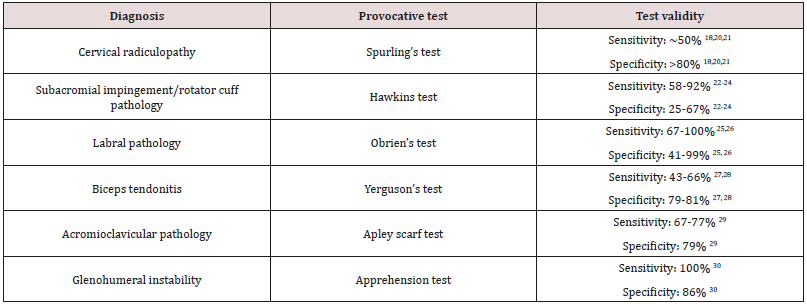
Provocative testing can assist in the diagnosis of cervical and shoulder disorders [9, 19]. Among them, provocative tests for shoulder impingement may help distinguish primary versus secondary shoulder pathology in proposed “neck-shoulder syndrome”(Table 1) [18-30].
In patients with neck and shoulder pain, one test by itself may not have enough sensitivity and specificity to make a diagnosis and most physical exam maneuvers are not pathognomonic. A combination of multiple exam components and a thorough history are necessary to accurately identify the etiology of symptoms.
Table 1: Provocative tests for common cervical and shoulder problems and reported validity.
Lupinepublishers-openaccess-journals-anesthesia-pain-medicine-journal

Diagnostic Testing

When presented with both neck and shoulder pain, history and physical exam should dictate appropriate use of diagnostic tests. Although imaging studies such as radiography, CT and MRI can reveal many pathologies, further testing should be done to identify the true pain generator. When suspecting pain mediated by a cervical zygapophyseal joint, cervical diagnostic medial branch blocks can be considered. A shoulder injection of lidocaine with or without corticosteroid can be done for diagnostic and perhaps therapeutic reasons. In cases of secondary shoulder pathology, this may give the patient partial benefit, but a primary cervical pathology should still be investigated [9]. Electrodiagnostic testing with electromyography (EMG) and nerve conduction studies (NCS) can be employed when suspecting myopathy, brachial plexopathy, peripheral neuropathy or radiculopathy. When evaluating neck and shoulder pain, scientific evidence suggests using a combination of history, physical examination, imaging modalities, diagnostic injections and electrodiagnostic study to make the appropriate diagnosis.

Treatment

Success of any proposed treatment algorithms will depend on an accurate diagnosis. There is scant evidence on how to approach the concomitant presentation of neck and shoulder pain. Treatment should be geared toward the primary site of pathology whether it be the cervical spine or the shoulder [3]. Lack of current literature evidence underscores the importance of describing a “neckshoulder syndrome,” as it can lead to studies looking at management differences. It can be hypothesized that in patients with cervical radiculopathy with secondary rotator cuff impingement, treatment of the primary lesion will likely yield eventual improvement at the secondary site although no studies have been done on this topic.


Conclusion

The concomitant presentation of shoulder and neck pain is a common scenario in primary care and orthopedic offices and can present a diagnostic and therapeutic dilemma. A careful history and thorough physical examination along with ancillary studies can often yield the correct diagnosis and successful treatment. Primary neck pathology resulting in secondary shoulder pathology is mechanically plausible but not proven. Authors are proposing this scenario to be described as “neck-shoulder syndrome.” Appropriately describing a “neck-shoulder syndrome” can lead to further studies looking at management differences. A prospective study looking at incidence of shoulder impingement signs in chronic C5 and/or C6 radiculopathy patients could be helpful in delineating diagnostic criteria for “neck-shoulder syndrome.” Above all, it is paramount to take a comprehensive and holistic approach towards patients presenting with concomitant neck and shoulder pain as the symptoms may not always represent isolated entities.


Acknowledgements

The authors would like to thank Dr. David Janerich for his help with the development of the article.


For more Lupine Publishers Open Access Journals Please visit our website:
For more Global Journal of Anesthesia & Pain Medicine articles Please Click Here:
To Know More About Open Access Publishers Click on Lupine Publishers: https://lupinepublishers.com/
 Read More Lupine Publishers Anesthesia Journal Articles : https://lupine-publishers-anesthesia.blogspot.com/
Read More Lupine Publishers blogger Articles : https://lupinepublishers.blogspot.com


Tuesday, July 23, 2019

Detox - Haemofiltration for The Neuroleptic Malignant Syndrome | Lupine publishers

Journal of clinical anesthesiology | Lupine publishers

 Abstract

Removal of serum toxins using haemofiltration with human albumin has been demonstrated to be a useful option for the treatment of a patient following the ingestion of unknown substance. Here, a case is described in which a patient presented with symptoms of neuroleptic malignant syndrome after ingesting an unknown Nigerian herbal remedy. Albumin enhanced continuous veno-venous haemodialysis has been previously used for intoxications. When combining continuous renal replacement therapy with albumin, the toxins are bound to the larger molecule which prevents the toxins moving through the filter; allowing for clearance from the blood. We suggest that Intensive Care Units should consider basic tools, such as detox haemofiltration when an unknown poison is suspected.

Introduction

Neuroleptic malignant syndrome (NMS) is a medical emergency, made more difficult by the lack of any diagnostic investigations, making it an entirely clinical diagnosis. Four criteria are used as parameters for a likely diagnosis: a change in mental status, a muscle rigidity (lead-pipe type), hyperthermia and signs of autonomic instability. TOXBASE guidelines state that in cases of suspected poisoning, activated charcoal may be used within 1 hour of ingestion; However, in cases like this where the patient is late in presentation, options are more limited. To our current knowledge, there is no specific antidote, and recommended therapy is supportive only. A few case reports have suggested the use of CVVH, peritoneal dialysis, and haemodialysis. In the absence of any diagnostic tests, we felt it was prudent to initiate renal replacement therapy in an attempt to filter any precipitating substances, without waiting for the development of further symptoms. Here we discuss the use of albumin enhanced continuous renal replacement therapy to treat a likely neuroleptic malignant syndrome.

Case Report

A 60-year-old male presented to the Accident and Emergency Department with reduced conscious level, diarrhoea and vomiting. The patient had ingested an unknown powder sent from Nigeria two days before presentation, for use as a treatment for his recently diagnosed Hepatitis B infection. Other past medical history includes type 2 diabetes mellitus, hypertension and hypercholesterolemia, treated with metformin, gliclazide, ramipril and atorvastatin respectively. The patient’s wife subsequently gave a collateral history, explaining that the patient had taken the unknown substance from Nigeria, knowing that it would make him very unwell for 3 days. She called for the ambulance on the 2nd day due to his reduced conscious level and vomiting. Upon initial assessment, respiratory rate was 35/min, heart rate 115/min, blood pressure 100/60mHg and temperature of 39oC. On auscultation he had crackles at both lung bases, a finding consistent with a chest x ray that demonstrated bilateral infiltrates, suggestive of either bronchoaspiration or pulmonary oedema. Cardiovascular and abdominal examinations were otherwise unremarkable. On neurological examination, there was severe lead pipe rigidity of all four limbs and neck stiffness accompanying a Glasgow Coma Score (GCS) of 10 (E3 V2 M5), though with normal pupillary reflexes. Arterial blood gas results were: pH 7.22 pCO2 7.11, pO2 14.4, Hb 132, Glucose 12.6, Lactate 1.6, Base Excess- 4.9, HCO3 19.4. Abnormal blood tests included: Urea 15.8, Creatinine 207, CK 1600, WCC 3.1 (neutrophils 2.1, lymphocytes 0.8), INR 1.4. CT Thorax abdomen and pelvis showed bilateral patchy areas of consolidation, ground-glass opacities and air space opacities suggestive of aspiration pneumonia. CT head was normal. [1-4] ECG and bedside echocardiography were normal. An uncomplicated intubation was performed due to hypercapnic respiratory failure and reduced GCS, and the patient was transferred to the intensive care unit. A nasogastric tube was inserted and 300ml of yellow-brown fluid was removed. The following antibiotic treatment was commenced: co-amoxiclav, clarithromycin and amikacin. High flow continuous veno-venous haemofiltration in combination with IV human albumin was started to remove potential precipitating agent. The patient improved quickly, and the small dose of noradrenaline started on day 1 was weaned off within 24 hours. The muscle rigidity improved slowly over 4 days but became the primary issue, along with inappropriate waking from sedation. A repeat CT head was performed which was normal, and an EEG was also normal. The neurological symptoms improved by day 5 and he was successfully extubated. He spent a subsequent 3 days on the unit until his pneumonia was fully resolved and was discharged on day 9.

Methods

High volume veno-venous filtration was performed using an Aquarius System. Blood was driven through a highly permeable haemofilter type Aquamax HF 12 poly-ether-sulfone from Baxter (cut-off point of 30.000 Dalton); systemic anticoagulation was also added into the haemofilter and pre-dilution mode was used. Extracorporeal blood flow ranged from 250 to 360ml/min (60ml/ Kg). The principle of clearance in this model of continuous dialysis was convection. No fluid was taken from this patient to maintain haemodynamic stability. The procedure was performed over the course of 48h. Albumin 20%, 100ml, was administered three times during the procedure due to the expectation that toxins would bind to the albumin which has a high molecular weight and will be trapped by the filter .Toxicology was contacted on admission; Dantrolene was considered but not administered, as it was unclear at the time whether this was a NMS; we were advised to use it only if autonomic disturbances were present. A screening of > 1000 substances were tested in the National Laboratory of Toxicology but non potential toxics were identified.

Discussion

According to the patient’s family, the substance which he ingested was a soluble powder sent from Nigeria called “agumu”. After researching this term, we have discovered this is a generic name for “medicine” and has multiple different references, but not 1 specific treatment [5-8]. The substance was sent for toxicological analysis at a national laboratory testing for 1500 different drugs but was not flagged as positive for any of them. We performed a literature search and found that there is a very limited amount of information regarding Nigerian herbal remedies which fit the description provided by the family of the patient. We were able to identify 1 compound, Rauwolfia Vomitoria that has been used in Nigerian herbal remedies for several purposes, and is known for its anticonvulsant, analgesic and antipsychotic properties. This compound has a similar effect profile as Chlorpromazine, which is a dopamine antagonist, and can cause neuroleptic malignant syndrome in overdose. Unfortunately, we did not discover the true identity of the substance, so further speculation is not helpful. However, the usefulness of the albumin haemofiltration may still be discussed. Many antipsychotic medications are highly lipid soluble and have high levels of protein binding. The above example of chlorpromazine has a 90-99% protein binding capacity. In the severely affected patients, it is theoretical that increasing serum albumin levels would increase the bound fraction of the drug, and therefore prevent the drug from moving through the filter. On the other hand, it is not clear whether patients with a normal endogenous serum albumin concentration would already have sufficient levels of protein binding capacity. Due to the severity of the case, the potential harm caused by line insertion and filtration is likely outweighed by the potential benefit, as these patients often end up on the filter due to renal failure secondary to either direct drug nephrotoxicity or secondary effects from high creatinine kinase levels.

Conclusion

Thankfully, this patient made a full recovery, and we have counselled him regarding the ingestion of unknown substances before discussion with a doctor. Due to many confounding factors in this case, it is difficult to demonstrate causality with any single intervention. However, these patients can prove to be challenging, especially in the early stages of presentation where the history is unclear. With the lack of diagnostic tests, and the inevitable delay in serum drug sampling, it is reasonable to start therapies which are likely to do little harm but may have a large positive impact. We believe the albumin hemofiltration is such an example.

For more Lupine Publishers Open Access Journals Please visit our website:
https://lupinepublishers.com/

For more Journal of clinical anesthesiology Please Click Here:
https://lupinepublishers.com/anesthesia-pain-medicine-journal/index.php

To Know More About Open access publishers Please Click on Lupine publishers

Monday, June 24, 2019

Lupine publishers publication ethics


Lupine Publishers Publication Ethics Publication Ethics: All the Journals in Lupine Publishers adheres to the highest possible ethical standards, for example, by the International Committee of Medical Journal Editors (ICMJE). If an ethical problem related to a submitted or published article is referred to the Editorial Board member, then he will evaluate the problem as outlined by appropriate bodies such as the ICMJE and the Committee on Publication Ethics (COPE), and take appropriate steps. The following are problems in the ethics of publication that every author should be familiar with. Violations of any of the following ethical principles may incur sanctions described below. Plagiarism All journals published by Lupine Publishers are committed to publishing only original material, i.e., material that has neither been published nor is under review elsewhere. Lupine Publisher’s journals as a participant of plagiarism pro software tool, to detect instances of overlapping and similar text in submitted manuscripts. Manuscripts that are found to have been plagiarized from a manuscript by other author(s), whether published or unpublished, will incur plagiarism sanctions. Duplicate Submission Manuscripts that are found to have been published elsewhere, or to be under review elsewhere, will incur duplicate submission/publication sanctions. If author(s) have used their own previously published work, or work that is currently under review, as the basis for a submitted manuscript, they are required to cite the previous work and indicate how their submitted manuscript offers novel contributions beyond those of the previous work. Citation Manipulation Submitted manuscripts that are found to include citations whose primary purpose is to increase the number of citations to a given author’s work, or to articles published in a particular journal, will incur citation manipulation sanctions.
Data Fabrication and Falsification Submitted manuscripts that are found to have either fabricated or falsified experimental results, including the manipulation of images, will incur data fabrication and falsification sanctions. Redundant Publications Redundant publications involve the inappropriate division of study outcomes into several articles. Publisher Responsibilities:  The publisher is committed to follow and comply with the International Committee of Medical Journal Editors (ICMJE) Recommendations.  The publisher does not influence the editors’ decisions and pledges the review process probity.  The publisher is committed to respond to research misconduct complaints promptly, received atsupport@lupinepublishers.com. Use of Human and Animal Subjects: In any studies, involving human subjects must include a statement that their relevant institutional committee has approved the described work. In the case of experiments involving animals, the author(s) should provide a statement assuring that the described experiments have been approved by the relevant institutional committee. The following is a summary of our expectations from editors, reviewers, and author(s) to follow the publication ethics standards and the procedures of handling the unethical behaviors.

Tuesday, April 30, 2019

What is the role of Editors in Lupine Publishers?


Editor Guidelines
The main epigram of Lupine Publishers is to spread scientific knowledge globally by publishing quality articles in their open access journals. The credibility of published articles completely depends on the effective peer review process; Hence, editors are the chief support for Lupine Publishers. The Editorial board members of Lupine are responsible to make it as quality manuscript publisher which are received from authors on various subject areas.
Roles and Responsibilities:
  • Actively look for the views of associate editors, authors, readers, reviewers and editorial board members about ways of improving their journal's content.
  • Reputation of our group is enhanced by the presence of eminent editors. They also must endeavor to set higher standards for the journal whenever possible.
  • Sustain initiatives to educate researchers and young scholars about publication policies and ethics.
  • Editorial board members are most welcome to give their valuable suggestions for organizational progress.
  • Editors can review submitted manuscripts based on their feasible time, if time does not allow reviewing the manuscript, editors can suggest other reviewers.
  • Editors will look after any confidential data regarding the task. If the author has used information of certain individuals, specifically in any of his medical or scientific records, the editorial Team must look for written consent from the individual, for the record to qualify for publishing.
  • Grabbing editorial decisions at the right time and communicating in a clear manner.
  • The validity of the scientific facts stated must be checked and the criticism of the manuscript should be left open for all to decide.
  • The editorial board members must assure that published content is original. The reliability of the author's work is a must, so there must be proper citation and the original source of the content should be named.
  • The final decision regarding modification, acceptance, or rejection of a manuscript rests solely with the editor.
Benefits:
  • Editors can be promoted as senior editor and executive editor in the concerned journal based on their active participation and also based on their experience.
  • Editors will be given highest priority in all the events that are organized by Biomedical Journal.
  • Based on their kind contributions and their efficiency, there is a chance to serve as a prominent member of the advisory board.
  • After one year of due course, Editor-in-Chief will be announced for every journal based on their active participation, expertise in the field, contribution towards the Journal and also their scientific contributions.
  • The review comments that are given by the editors will be strictly followed after which the authors will be requested to modify their manuscript according to the editor’s suggestions.
  • We promote all the articles of the Editors that are published in our journals, in various social networking groups from our end, increasing visibility for their works.
  • Our journals consider Editorials as a note to the young researchers and scholars.
  • Editors shall be honored in position as Chair/Co-Chair for any conferences organized by us and also the fee will be waived.
https://www.quora.com/What-is-the-role-of-Editors-in-Lupine-Publishers

Monday, April 1, 2019

Brain Death_Lupine Publishers

The Cellular Dust Hypothesis and The Laws of Thermodynamics by Seun Ayoade in Global Journal of Anesthesia & Pain Medicine in Lupine Publishers 

  
The cellular dust hypothesis states that all life (including human life) and the physical universe/entire cosmos came to be as a result of the activities/chemical reactions carried out by indestructible microscopic (maximum size 500 nanometre) entities called microzymas [1]. Discovered in the mid-1800s, alternative terms for macerozymes include cellular dust, protits, bions, scintillating corpuscles, siphonospora polymorpha etc [2].

https://lupinepublishers.com/anesthesia-pain-medicine-journal/pdf/GJAPM.MS.ID.000110.pdf

For More Open Access Journals on Lupine Publishers Please Click on Link: https://www.lupinepublishers.com

For More Articles on International Journal of Surgical Oncology Please click on link: http://www.lupinepublishers.com/anesthesia-pain-medicine-journal/

Friday, March 15, 2019

Vascular Surgery_ Lupine Publishers

Anesthesia for Transurethral Resection of Bladder Tumors in Patients with Neuropathy Caused by Balloon- Occluded Arterial Infusion Treatment: A Retrospective, Observational Study in Global Journal of Anesthesia & Pain Medicinein Lupine Publishers

A novel bladder preservation therapy has been developed for patients with muscle-invasive bladder cancer called the Osaka Medical College (OMC) regimen. This regimen comprises balloon-occluded arterial infusion (BOAI) of an anticancer agent and with or without concurrent hemodialysis. Anticancer agents, such as cisplatin, can cause neurotoxicity, leading to peripheral neuropathy. This study aimed to investigate the occurrence of neuropathy after BOAI followed by a second transurethral resection of a bladder tumor (TURBT). We also aimed to investigate the effects of general and spinal anesthesia on neuropathy.


For More Open Access Journals on Lupine Publishers Please Click on Link: https://www.lupinepublishers.com

For More Articles on International Journal of Vascular Surgery Please click on link:


Tuesday, March 12, 2019

Surgical Oncology_Lupine Publishers

Anesthesia for Transurethral Resection of Bladder Tumors in Patients with Neuropathy Caused by Balloon by
Junko Nakahira in Global Journal of Anesthesia & Pain Medicine in Lupine Publishers
A novel bladder preservation therapy has been developed for patients with muscle-invasive bladder cancer called the Osaka Medical College (OMC) regimen. This regimen comprises balloon-occluded arterial infusion (BOAI) of an anticancer agent and with or without concurrent hemodialysis. Anticancer agents, such as cisplatin, can cause neurotoxicity, leading to peripheral neuropathy. This study aimed to investigate the occurrence of neuropathy after BOAI followed by a second transurethral resection of a bladder tumor (TURBT). We also aimed to investigate the effects of general and spinal anesthesia on neuropathy.

https://lupinepublishers.com/anesthesia-pain-medicine-journal/pdf/GJAPM.MS.ID.000104.pdf


For More Open Access Journals on Lupine Publishers Please Click on Link: https://www.lupinepublishers.com

For More Articles on International Journal of Surgical Oncology Please click on link: http://www.lupinepublishers.com/anesthesia-pain-medicine-journal/

Wednesday, March 6, 2019

Vascular Surgery- Anesthesia Pain Medicine Journal


Anesthetic Considerations in A Case of Arnold Chairi Malformation Type II by Bhavna Gupta in Global Journal of Anesthesia & Pain Medicine in Lupine Publishers

Abstract
Arnold chiari malformation (ACM) Type II is a developmental abnormality of the brainstem and cerebellar tonsil, medulla and protrusion of 4th ventricle into cervical spinal canal. To best of our knowledge, there is paucity of literature regarding anesthetic management of cases with ACM type II. The anesthetic concerns with general anesthesia are related to the risk of autonomic dysfunction, difficult airway management, damage to the spinal cord and sensitivity to neuromuscular blocking agents. There is risk of increasing intracranial pressure and brainstem compression or herniation leading to hemodynamic and respiratory compromise, due to presence of meningomyelocoele, syringohydromyelia and tethered spinal cord

https://lupinepublishers.com/anesthesia-pain-medicine-journal/pdf/GJAPM.MS.ID.000106.pdf

For More Open Access Journals on Lupine Publishers Please Click on Link: https://www.lupinepublishers.com

For More Articles on International Journal of Vascular Surgery Please click on link: http://www.lupinepublishers.com/anesthesia-pain-medicine-journal/

Happy Thanksgiving 2022!!

  Thanksgiving is a joyous invitation to shower the world with love and gratitude. Forever on Thanksgiving the heart will find the pathway h...